Berlin
I have been thinking about this for a long time. First there were gods, many of them. Then there was one God. Then we decided we did not need any of them. Humanity took the power for itself, placed it in the hands of scientists, in reason, in progress. We called it enlightenment.But I think power is something very hard to carry. And slowly, quietly, people started turning their eyes back toward something to believe in.
So now we have turned inward. Into the body. Into everything the body wants and fears and consumes.
This is where I find myself. This is where I find everyone around me.
Really. A person who has nothing left to believe in, who is going mad asking where to direct this power, how to fill this enormous emptiness, where does that person turn? Maybe toward this city.
Everywhere I go I encounter travelers who have been disappointed, standing before structures that have culturally lost all their power, helpless inside their own helplessness. Maybe every time I encounter them I see my own emptiness reflected back and feel myself pulled toward it.
When I first set foot in Berlin, it felt like that whole vast world of feeling had arrived before me. Everywhere I wandered, an excitement had already come ahead of me, already wrapped itself around the spaces and the people, already loaded them with meaning, already turned them into enchanted temples. I moved through it all like Hansel and Gretel who forgot to leave breadcrumbs. Bars, museums, my thesis advisor, women, markets, old workers’ coffeehouses. I drifted through the elegance of another world entirely. Nothing had a practical, material reality for me. Every person, every thing, every event, I moved among them as if they were all part of one enormous ritual.
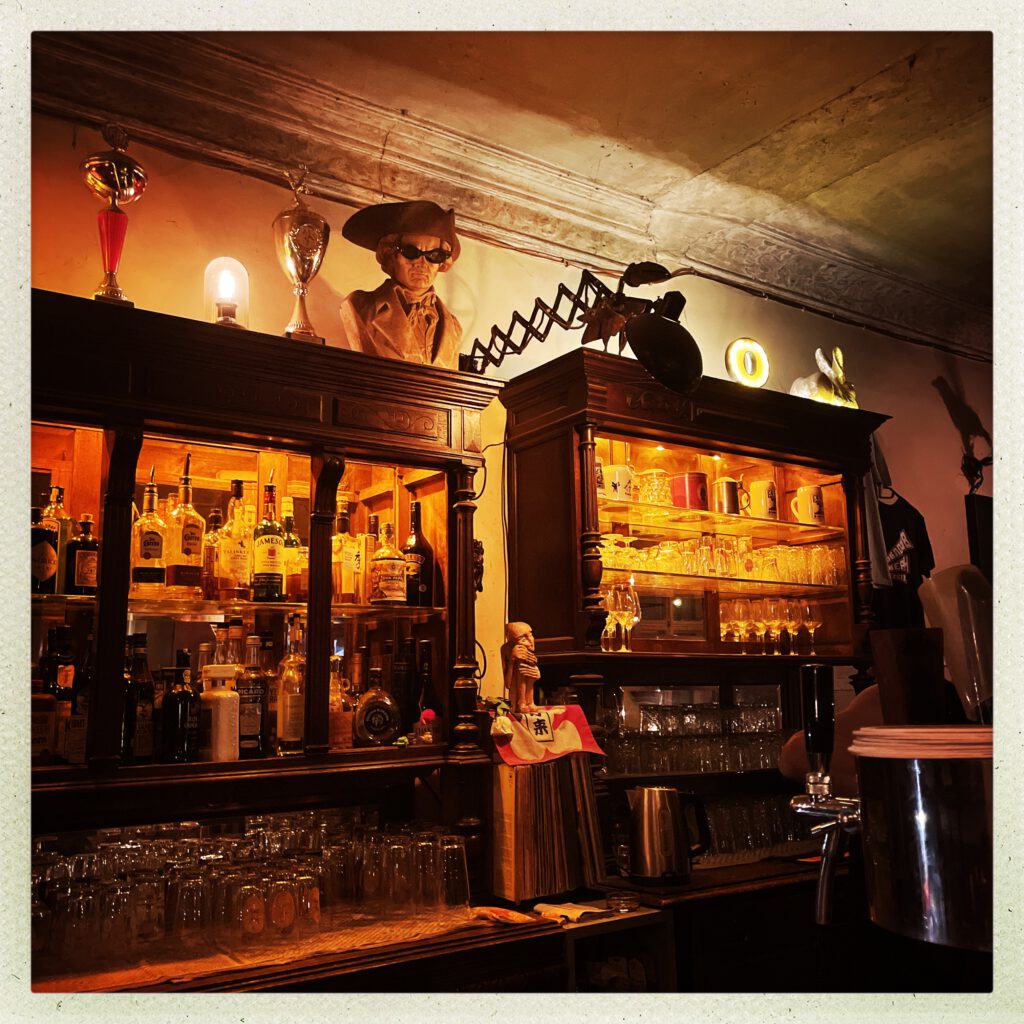
That first winter, wandering through the streets of Neukölln, I saw a bar with enormous windows, lit by candles. On the shelves behind the bar there was a rabbit. The Alice had arrived before me. And between those beautifully lit bottles, a face was looking at me. It had to be Beethoven. Something trembled inside me.
Yes. There, wandering half mad through the streets of this undefined city, I had seen something calling to me. That bar could not be anything other than the place I would return to again and again. I went in.
The flickering warmth of candlelight, the shadows on the walls, the people sitting at the tables. It did not occur to me then that those trembling lights might be reflections of the quiet, scratched away fears people carry inside them. They were simply the aesthetic elements of the Berlin dream that already occupied so much of my mind. They only added to my excitement. I went straight to the rabbit and Beethoven. I sat across from them. I had to open myself to whatever this enchanted world was going to bring me.
There is something Barney White-Spunner writes in the opening pages of Berlin: The Story of a City. He says that the real Berliners are actually the ones who have just arrived. And the first thing that defines this feeling of being a Berliner, for me, is vulnerability. You are so hungry for whatever this city might bring you that you open yourself, defenselessly, to every wound it might leave behind.
And so I had settled myself into that bar with exactly that kind of hunger. Waiting for the rabbit and Beethoven to give something back to me. I got my drink. I sat. I rolled a cigarette. I looked at the people around me, on the couches, at the tables, at the bar. In the room next door people were dancing, then crossing over to the bar side to talk and drink.
Cannabis was technically still illegal then, but Berlin, at least in my imagination, was an anarchist space, one that cracked open the door to stories people could tell about the places they slipped away to when they went to roll their cigarettes. There were no boundaries here. At home, the clothes I put on my body built a wall between me and the outside world. But in this place everything dissolved, like a slow fade. My thoughts and feelings met the thoughts and feelings of others, our eyes slipped into each other’s eyes, our desires and longings opened paths toward one another. It felt like we had no choice but to merge.
Because at home, completely alone, wrestling with all the fears and feelings of being a Berliner, a migrant, a stranger, here there was the joy of dissolving into each other. It felt like there was nothing to lose by getting close. Packed tightly together, we touched and smiled and said hello to the people moving between us, and talked. We were all chasing some ideal. We were all on a very important journey. And this place was like a travelers’ inn, a stop along the way.
Later I would learn that these feelings, these touches, these thoughts we mixed together were themselves nomadic. Everything would merge for a moment, dance together briefly, cause some great joy, then spill back out into the streets, maybe into beds at night, then dissolve completely in the friendships and relationships built on morning walks. I learned this later: everything that happened here was only for that moment, only in that place. We were nomads who could become one for an instant and then find ourselves completely alone again.
While Nietzsche wrote about the pain of severing attachments, we were being torn apart by the pain of forming them. The ability to let everything go as it is, to hold nothing, felt like the highest virtue here. Anything that became defined, named, fixed could turn into a terrifyingly painful experience.
I did not understand any of this then. That evening I left the bar carrying all those feelings that had settled over me, with the excitement of a prophet who had just received a message from God. I was afraid the feeling would disappear, so I spilled back out into the streets and found myself walking, involuntarily smiling. With every step something inside me was crackling, alive, and I did not want it to stop. I wandered along the canal, through the streets of Neukölln, looking at the bars around me. And then when I finally got home and put my head on the pillow, I fell asleep with that particular sadness that comes from being an ordinary person.
This is how I stood before everything in this city, through one ritual after another. The aura this city had put on, long before me, long before Berlin itself perhaps, had wrapped itself around me from every direction.
I was going to be a simple prophet of life. At university I would build great ideas, and through my art I would make those ideas practically real. Ozan and I used to talk about this all the time. He said we had a Jesus syndrome. I think the whole city had it. All of us were waiting for the day we would be crucified on our own journey. Until that day we would sit and rise with people, suffer betrayals, fight, chase our ideals, and then one day, needing no one else, we would crucify ourselves.
The interesting thing is that unlike Jesus, we had nothing to believe in, no god to represent, no cultural world to build. We had already lost all of that. And maybe that is exactly what would make us Berliners. The struggle of a person who has nothing, to become nothing.
This always resonated so deeply with something an acquaintance once told me, and I say acquaintance because calling someone a friend here feels like a sin, a personal one, one we do not say out loud. He told me: here you can experience your own limits, you can go beyond them, you can see where you end up. Coming to Berlin is perhaps exactly this, standing at the edge of a singularity. The place where everything eventually converges, where everything is shared, is also the process by which this black hole takes you, by your own hands, to crucify yourself at its center.
A capital city overflowing with people who are afraid to define anything in the middle of this endless existence. Afraid enough to lose their minds. People who cannot cope with it, cannot carry it.
There is only one thing left we turn our faces toward. The body. And the affects the body produces.
The ethical, political person of today, the person of Berlin, lives in a state of trying to experience these affects all the way down to their roots, in all their indefiniteness, while at the same time being terrified of naming them. Pulling them into anything defined is their idea of hell.
To love someone is a definition. Even choosing where to buy your groceries is a definition. I used to see people moving between two brands, declaring themselves loyal to one or the other, arguing about whose advertisement was better. Now virtue looks like this: living a life built entirely on the loss of attachment, belonging to none of it. And now, even when you want to feel love, even when you want to be loved, someone producing a definition of you, a name for what they are experiencing with you, before love has even had a chance to arrive, can send your body temperature exploding like a thermometer in a cartoon.
Now there are only experiences. So many people come to Berlin saying: I came to experiment with my sexuality. With nightlife. With the limits of my body. With my desires.
And this is it, really. God died. The outward facing eye of science died. And so we turned our gaze inward, toward the body, toward experience. Aesthetics, thought, ethics, none of it holds meaning anymore. Sentences begin with I feel this way, I feel that way, and end with the destruction of whatever boundaries produced them.
It is strange. From childhood, friendship had always held an important place in my world of meaning. Because for me, a true friend was like a Genossenschaft, a fellowship, a form of solidarity. It was also a way of fighting in this life. I always thought I built my relationships that way.
There was someone I thought I was sharing this experience of being a Berliner with, someone I thought I was struggling alongside. I know now, with certainty, that we were never really friends. But watching their relationship to the body, to experience, always struck me. Sometimes it genuinely horrified me.
When a person has made the body into their temple, their approach to it becomes something startling. We would be having a good time, eating something sweet, drinking happily, dancing, talking, and then a strange interruption would arrive. Because in their inner book, all of this was a sin against the temple. So instead of just the joy of a good meal we had to live that moment alongside the suffering of having committed a transgression. The next day there would be a fit of anger about not having gone to the gym. We would stand in front of the mirror and grieve the softness of our stomachs.
Yes. Today’s god and today’s devil are both entropy. Watching things pass from order into disorder is, for the person of today, something like a two-faced Janus. On one side a divine belief system, on the other a demonic pull that brings only suffering. The body is the direct center of both pleasure and pain. While our worlds of meaning fall into disorder, our bodies must remain in order. This contradiction burns.
Then one day a message arrives on my phone. A photograph. In the photograph, a pill. After thirty, our mitochondria slow down, metabolism slows, the body begins to collapse, and this pill reverses all of that.
This is what our whole struggle has come to. To turn the body into an infinite machine of pleasure and experience, while protecting it from anything that might define it within a world of meaning. Cocaine and speed exist today for exactly this reason, as the drug that kicks the body into endless motion. And alongside them, everything else, just to feel a little better inside all this suffering. These are the children of the new educated science.
And then there is the other side, which is even more interesting. Those who have completely lost their trust in the world of enlightenment, in the world built by those who won the world wars, and who are now chasing after a hidden knowledge. A knowledge they cannot even name, one that has been turned into a commercial product, concealed from us.
Strangely enough, the symbol of this search became Tesla. Someone you could actually love.
This same person used to send me Tesla water. They would talk about strange beds hidden somewhere in Holland, beds that send certain frequencies into the body to support it in its fight against entropy. They still do. Having been vaccinated their whole life by necessity, in recent years they began to rebel against that necessity, arguing that we must return to nature. On their Monday walks, perhaps in their own battle against entropy, they would try to take revenge against the pharmaceutical industry, that industry which sometimes frightened even me, the one that had left them face down in the fight.
And this is where we have arrived. On one side, letting the world of meaning and feeling pass through us like something temporary. On the other, trying to anchor the body in an infinite sameness, an eternal preservation. This has become something like the founding, sacred ideal of how to live.
In Berlin you do not even need to turn a corner to find them. The people who sell these pills, who bring these people their coffee, who paint their apartments, who clean their homes. People who have perhaps long since made their peace with the practical reality of life, who will not enter into any struggle against entropy. People my friends would sometimes call monsters, sometimes call ignorant, but who could also earn a certain respect when they served them well.
I have met so many people here who live by a practical ethics I cannot fully understand. I still do not know whether it is conscious, or whether life has simply automated it into them, or whether it is class consciousness. Life is what it is, they seem to say, and they put all their energy into maximizing what they can get from it. There are more of them than all the others combined, but strangely they are invisible. Their invisibility comes from the fact that they do not consume anything aesthetically.
With my mitochondria friend, the body is an aesthetic object, even if on a positivist foundation. They consume their own body aesthetically. They go to the gym in pain, they maintain their white collar life in pain, they tell their friends stories about how to get into Berlin’s nightlife venues, about the dark rooms. These practical people are not outside that world, they are in it, but only to the extent that they can serve the aesthetic life.
For any worker, the body, thoughts, glances, tastes, these are simply practical things.
One day while working at Gorki I went to the canteen. I was hungry and I wanted to eat something good. By then I had started checking the nutritional values of everything I bought, how it was produced. I saw fish. My mind was not on the pleasure of a good meal, not on getting energy for the hours of exhausting work ahead, but on the protein, the measurable contents, how much of what was in it could function as glue for my body.
The man working in the canteen was a Turk who did not like Turks. I asked him how the fish was.
Dead, he said.
I do not know what makes something funny. But after all those thoughts that had just passed through my mind about eating that fish, something about that answer was so simple, so relieving, that I burst out laughing. Even now I cannot think of it without laughing.
After that a friendship formed between us. He loved it when I said to him keyfin bol olsun, may your pleasure be plenty. What a beautiful greeting, he would say. He tried to teach me what he knew. That I needed to go to the flea market very early in the morning because the good things get taken straight away. That I should stay away from women who dye their hair red because they are working on their outside since they cannot change their inside. That I should not close myself off to Germans because there is a lot to learn from them. He showed me the location of an old fishmonger in Charlottenburg where you could still find traditional fish. And sometimes, though he never pointed them out to me, I noticed the good drinks he kept hidden at the back of the canteen. His small tactics. Every now and then he would offer them to the chefs, to the people he was close to, to his dear ones.
Berlin was layered beyond good and bad, beyond dream and reality, beyond sadness and joy, beyond home and homelessness. We were temporary not only in space but in the body and in identity too. Late at night, reading and writing texts, I was a doctoral student. Out on the streets, wandering, there was an aesthetic side to life. I moved between these versions of myself without noticing the seams.
I had come to Berlin full of anticipation for the days ahead. Walks with my professor, books I would read and share with colleagues, a life of ideas made real. Instead I found myself searching for the tactics of survival.
One of those dreams found me while I was fleeing one apartment and taking shelter in another. A woman in her seventies, living near Admiralbrücke, was renting out a room in her apartment. A large room with high ceilings. A bed, a wardrobe, a desk. That is enough, I said.
While we talked she mentioned she usually cooked and I could bring something to drink and we would eat together. When I asked about the Anmeldung she said, move in first, we will decide later.
Dostoevsky was moving through my mind. A small desk where I would do my work, a bed to sleep in, I would wander along the canal, maybe I would meet Nastenka. Then I would come back and write all my impressions in my room. Frau M would cook the meals.
Slowly that dream began to turn into a nightmare. When things reached a point frightening enough that my door was being opened at night, I threw myself out into the street. I got on my bicycle. I rode and rode. I went to Tempelhof. I thought maybe if I rode fast enough I could escape the aura that had attached itself to me. I accelerated, shifted into a higher gear. And right at the moment when something like excitement began to stir inside me, my tire burst.
Since arriving in Berlin I had not cried over anything. In that moment I started crying. I sobbed.
Then I began wandering the streets with my bicycle. I was looking for a repair shop when someone passed by carrying many bags, the kind of person Berliners can picture when they imagine someone living on the streets, the shape they sketch in their minds. They passed looking at me. They looked and kept looking. That I had been crying, that I was unhappy, was visible in everything about me. But they did not ask me about that. They started talking about the bicycle wheel.
They asked where I was from. I said Mesopotamia. Are you Kurdish, they asked. I said Mesopotamian. For some time it had felt more liberating to define myself through nature itself rather than through any race, nation, or flag. They smiled.
Where are you from, I asked. They listed dozens of cities.
Then they began going through their bags. They pulled out a box of chocolates. These are past their expiration date according to what is written on them, but don’t be fooled, they said. When things like this happen people throw everything away and the shops cannot sell them, so I go and collect the expired ones. We laughed.
Look, they said. A moment ago you were very unhappy. Now I have given you a chocolate and you are happy. Life will always be like this, don’t worry.
We walked together, me with my flat tire, them with all their bags. They told me they loved films very much. I asked their name. Tony Montana, they said. When they asked mine I said Noodles. Now they were laughing hard. We walked for a long time.
When we said goodbye they said, I may not see you again, but if I pass by you, call out to me. They walked away. Goodbye Noodles, they called back.
After that I started asking people the thing they had not asked me. Have you cried lately, and why?
One day I went out to walk and think through the texts and notes I had been reading. In winter in Germany people stand on two feet, turn toward the sun, and fall asleep like meerkats. Everyone sleeping standing up. I always thought, what a shame none of us ever falls down like a meerkat and completes the thing properly. How lovely that would be.
I went to Mauerpark. I climbed to the top of the hill. There were beautiful women. I leaned my back against a tree and stood there, stood there. I closed my eyes. When the sun hits your eyelids they go that deep red. It feels like closing your eyes opens them onto another world entirely. I like following the little bubbles of light that appear there. Then I let my eyes go soft, half open. Open but closed. Or closed but a little open too.
I thought about how worshipping the sun must be one of the most material, most logical beliefs in all of human history. To worship the sun. Anyway.
I walked again. I went to the parks I love. A woman smiled from a distance. She was lovely. I should come back to this park, I thought.
Then I walked again down Stargarder Strasse. I was walking. A woman approached from a distance. Our eyes met. Then I saw what she was carrying against her chest, a baby carrier, and I think I had seen her eyes first. That kind of gravitational pull. Extraordinary.
Then I noticed her boots. Those mid to upper class ankle boots, their laces undone.
We looked at each other. We smiled. Neither of us said anything. I moved toward her. I bent down in front of her. I took her ankle in my hands. I put her shoelace back in place, and because they were so long I wrapped them once around her ankle and tied them at the front. When I stood up she made a gesture with her eyes and her smile.
And we went on our separate ways.
I always think that language is not the place where meetings happen but where partings do. The joy these wordless images create in me is beyond measure.
What a happy moment. What a happy moment.
But the very streets where all these thoughts and moments lived, where they were thought and felt, would by the next morning become entirely practical territory for me. My solution to having no money was to work for a company with a gorilla theme, cycling through those exact same streets with groceries on my back, delivering them to people’s homes.
I was now navigating the same streets as a workspace. Who tips better. Where are there more traffic lights so I can catch my breath for a moment. If the delivery address happens to be near a park, maybe I can slip away from the managers tracking us by GPS and sit in that park for a while. If by evening some of the products from that company I loved so much are close to their expiration date, maybe I can take them home for free.
I sometimes think about my grandfather when he came here. Everything was so clearly defined for him. He would go to his shift, come back when it was done, sleep a little, then get together with the families of friends from Turkey. And that cycle would continue. I was a nomadic existence, shifting from identity to identity, from home to home, from aesthetic to aesthetic, every hour of the day wearing a different face. And I was not alone in this.
Coming to Berlin, not just from Turkey but from anywhere in the world, people almost always fell into a disorienting loss of identity that seriously tested them psychologically. The delivery work I was doing was like that. And there were other jobs too, jobs where you had to look at all the terrible images the world produces and sort through them. Working in the service sector was the most fundamental experience for those who had just arrived.
At least while we stood in a queue of sixty people outside a warehouse in Prenzlauer Berg, waiting for the next delivery order, we talked. Chile, Argentina, Palestine, Syria, India, Turkey, Italy, so many people from so many different beliefs and places. I even met a flat earther there. Painters, actors, musicians, academics, so many people waiting in line both for a delivery order and for the chance to one day do the work they actually dreamed of. And sadly, many of them were more talented than anyone I had encountered in Berlin’s galleries and on its stages.
Everyone’s dreams had driven them straight to the center of exploitation.
In the old days, when people worked in factories, the culture industries Adorno wrote about existed alongside that exploitation, entertainment spaces designed to release the pressure just enough to send the worker back into the cycle. For us, that mechanism ran through our daydreams. I wanted to be an academic. A friend of mine wanted to be a theatre actor. To one day reach those dreams, to build a life on the road toward them, we had to say yes to every job that came our way.
Berlin’s cafes were full of artists. The people delivering food and groceries to your door, cooking those meals, cleaning those restaurants, carrying your packages. And it was very hard to carry that.
One day a friend told me the only way he could bear it was to smoke a joint after delivering the first load of the morning, which we always had to carry on our backs because of the gorilla theme, and only then could he manage eight hours of cycling through the city with weight on his back. On top of everything there was the constant fear of being fired, the anxiety of the company’s six month trial period always hanging over him.
And so we were modular people. The feelings and thoughts of being a worker, the feelings and thoughts of being an artist, and on top of all that the desire to be an academic and the form of analytical thinking, all of it taking turns throughout the hours of the day.